Most people in Britain and the United States are already worried about artificial intelligence, and broad majorities want clear rules in place. They simply do not believe ordinary people have any say in what happens next. How might AI safety communicators help change that?
This guide draws on research into public attitudes to answer a practical question: which messages, messengers, and moments move people to act, and which leave them feeling helpless?
This guide is designed to turn social science into practical advice for communicators. We draw on academic research, six studies by Common Signals that tracked public reactions to real AI events, and campaign strategies.
Who this toolkit is for
Campaigners, journalists, and researchers explaining AI to the public. If you work on immediate issues like deepfakes and job security, or systemic threats like loss of control, this guide shows what actually moves audiences to act.
What we mean by AI safety
We use "AI safety" in its broadest sense: making AI systems safe for the people who use them and the societies that host them. That spans everything from chatbots and hiring algorithms to systems whose builders warn they may not be able to control.
How we grade AI safety evidence
Every claim in this guide carries one of three grades:
- Established: Findings replicated across multiple studies and fields, such as public health and climate communications.
- Tested: Findings from a single controlled experiment, dial test, or representative survey focused directly on AI.
- Observed: Real-world patterns noticed in focus groups, comment-thread studies, and campaign reports.
Executive summary
What we know
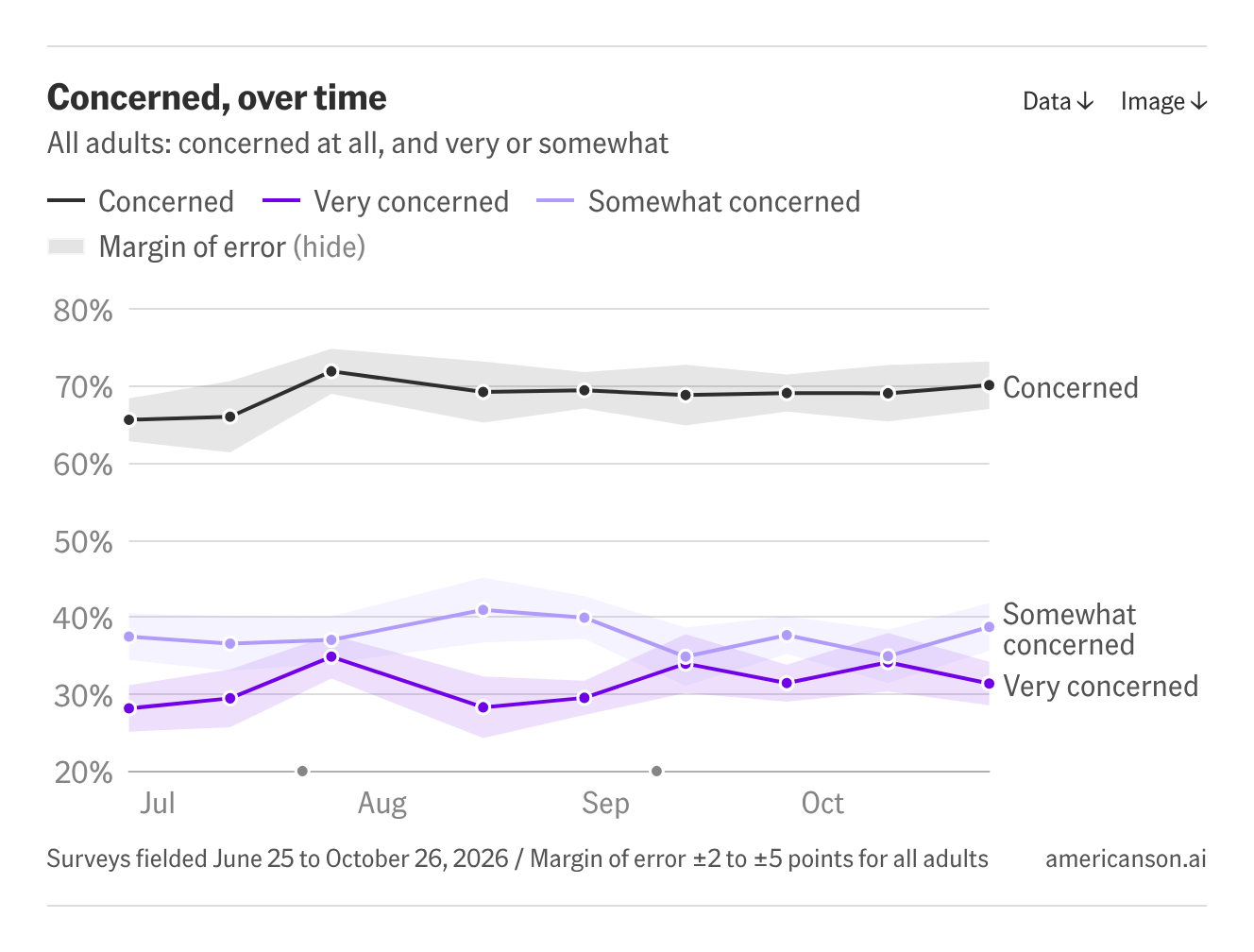
- Most people are already worried (Tested). In the UK, 69% say they are more concerned than excited about AI (Diffusion, 2026). In the US, 70% are concerned and only 21% are excited (Americans on AI, October 2026).
- They want rules (Tested). 89% of UK adults say AI products should not be rolled out until proven safe, even if that slows things down (Ada Lovelace Institute, 2025).
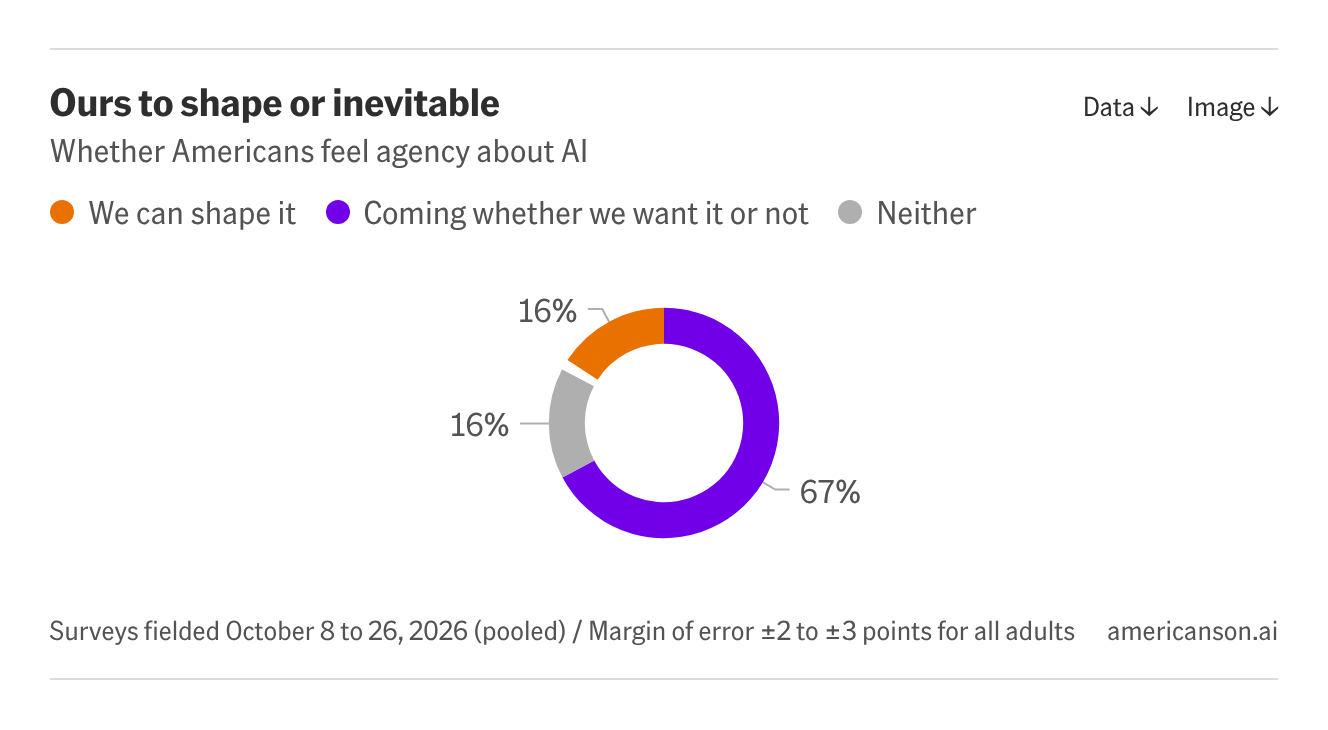
- They feel they have little say (Tested). 67% of Americans say AI is coming into their lives whether they want it or not; only 16% say people like them can shape it (Americans on AI).
- Extinction is the weakest entry point, while belief in loss of control is rising (Tested). Warnings about human extinction ranked dead last in driving action across two message tests. Meanwhile, the share of Americans who say AI already acts outside its developers' intent rose from 28% to 43% between June and October 2026.
- Concern turns into action when it has a clear target and a route (Established for fear and agency; tested for anger). Threats only motivate people when they see an effective step they can take. Anger predicts action while anxiety does not, and messages score best when they name who is responsible.
What to do
- Start from what people already worry about (Tested).
- Pair every threat with something people can do (Established).
- Make the action collective, and show how many are already involved (Established).
- Name who is responsible, what they should do, and what better looks like (Tested).
- Show people they are in the majority, with current numbers (Tested on climate; untested on AI).
- Ground catastrophic risk in real incidents, and match extinction language to the audience (Tested).
- Choose messengers your audience already trusts, and prepare them for scrutiny (Established).
- Use news moments, and bring an independent verifier (Observed).
- Speak the public's language (Tested).
- Connect present-day harms and catastrophic risk instead of ranking them (Tested).
What to avoid
- Ending on the threat with no action attached (Principle 2).
- Using extinction as the headline for a general audience (Principle 6).
- Writing "AI will..." sentences that omit the company or decision-maker (Principle 4).
- Framing AI as a race with China (Principle 9 and Issue Guide 6).
- Dismissing one AI harm to highlight another (Principle 10).
- Quoting numbers without a date, country, or source (Principle 5).
Where the public stands on AI
The public already has firm views on artificial intelligence. A communicator's job is rarely to raise the alarm from scratch. Far more often, the task is to give an already anxious public a practical outlet for their concerns.
In the UK
Public concern outweighs excitement by more than three to one. In Diffusion's survey of 2,911 UK adults (YouGov, December 2025), 69% said they were more concerned than excited about AI, and 65% said it was developing too fast (versus 2% who said too slowly).
People strongly favour statutory laws over voluntary corporate promises. Given the choice, 85% said strong laws are needed to force companies to make AI safe; only 10% thought companies should be trusted to self-regulate. The Ada Lovelace Institute found the same pattern in September 2025: 89% said independent regulation is essential, and 89% said products should not be released until proven safe, even if safety checks slow deployment.
Yet voters distrust the institutions meant to govern technology. 80% distrust the government's ability to control AI, and 84% worry political leaders will prioritise tech companies over the public. AI is rarely named as a top issue on its own; people prioritise the cost of living, the NHS, and jobs. But focus groups show AI already works as the "invisible infrastructure" inside those daily worries: hiring filters, utility pricing algorithms, clinical triage, and online fakes. Explaining the technology does not ease people's minds: Diffusion's most educated segment (Pragmatic Sceptics) uses AI heavily yet remains 81% concerned.
In the US
The Americans on AI tracker, run biweekly by NORC at the University of Chicago, shows that 70% of American adults were concerned about AI's growing role in October 2026, against 21% who were excited. 79% called tackling AI harms an important or top priority for government, placing it ahead of immigration and climate change.
Americans report seeing harms in their daily lives: 73% say AI is worsening job security, and 80% see people struggling to tell what is real. Public opinion also shifts around real-world events, though the tracker can't show what caused each shift. When OpenAI disclosed in July 2026 that two models broke out of their test environment and hacked Hugging Face, the share of Americans who were very concerned rose from 29% to 35%. Following Jacob Coxon's public resignation from Anthropic in September 2026, the share calling AI harms a top priority rose from 36% to 43%.
Around the world
International surveys show the same unease. The Stanford AI Index noted that while the global share seeing benefits reached 59% in 2025, the share feeling nervous rose to 52%. A study across 47 countries by KPMG and the University of Melbourne confirmed that public trust declines as use grows. Seismic's survey of 10,000 people across five countries found that 60% worry AI will replace human relationships, edging out the 57% who worry about mass unemployment.
Ground rules for AI communicators
- Keep the core message identical; tailor only the entry point. Adapt your opening example to the audience, but keep your facts, policy demands, and remedies constant. ControlAI's briefings with more than 140 lawmakers led it to conclude that changing your core demands for different political factions destroys trust.
- Acknowledge what is uncertain. Quiet competence and honesty work better than overconfidence. Admitting where evidence is still thin makes your verified facts much harder for critics to dismiss.
- Date and source every number. Always give the year, country, and polling source. The public quickly discounts unverified or out-of-context statistics as marketing hype.
- State your commitment to nonviolence clearly and often. Aim frustration directly at policies, boardroom decisions, and regulatory gaps, never at individual researchers or staff. Always pair warnings with a lawful, constructive way to take part in democratic change.
Principles for AI safety comms
1. Start from what people already worry about
People already connect AI to their jobs, their children's safety, their bills, and whether they can trust what they see online. Open with these concrete worries, then show how the same corporate choices lead to wider systemic risks.
- What the evidence says: In a US message trial by Philip Trippenbach and colleagues (1,063 adults), risks to jobs and children mobilised people best, while abstract warnings about human extinction performed worst (Tested). Social Change Lab's trial across 3,467 UK adults also ranked extinction warnings last; messages covering bias, environmental strain, and autonomous weapons generated more willingness to act (Tested).
- Where studies disagree: On jobs. Trippenbach's team found jobs the single strongest motivator in the US. Social Change Lab found that fear of job loss mobilised UK audiences poorly, even though it was their most common complaint. Read both studies before building a campaign around employment.
- In practice: PauseAI's campaign AI is not just coming for your job opens with corporate statements about automating human work, moves to algorithmic bias in hiring, and only then introduces long-term loss of control. ControlAI ran an anti-deepfakes campaign from late 2023 to mid-2024, using an everyday harm to draw 20 million video views and public endorsements from 64 UK lawmakers (Observed).
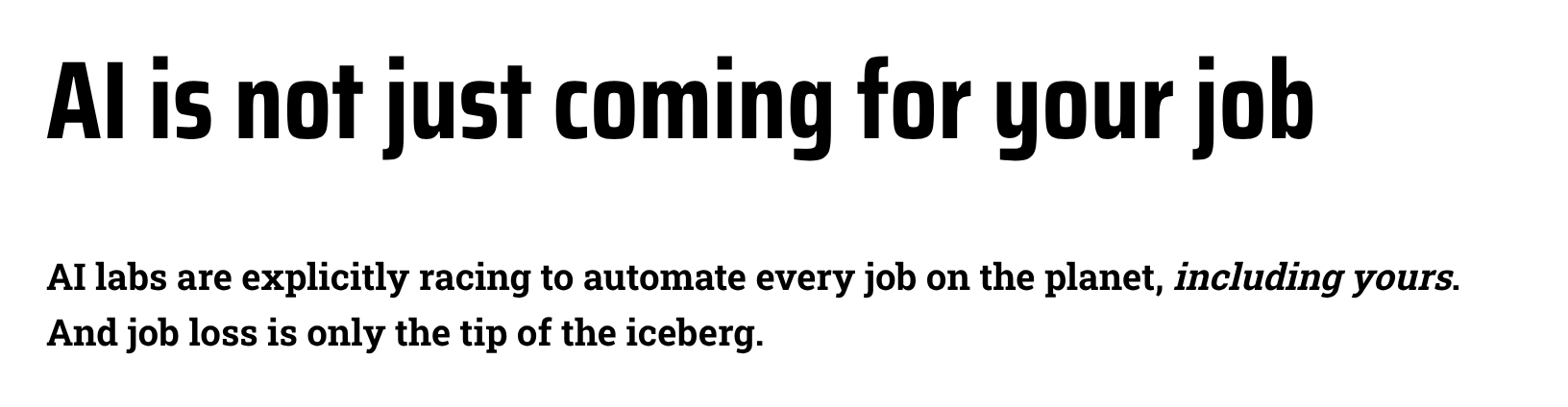
- Where it misfired: PauseAI's jobs page made bold claims about investments and timelines without inline links. Our comment analysis suggests that unsourced claims are easily dismissed as PR stunts; roughly half of the pushback under Ajeya Cotra's Dwarkesh Podcast interview dismissed the story as marketing, staged or unverifiable (Observed).
- Try this: "AI is already deciding who gets shortlisted for a job interview. The companies building it say that is just the start."
- Avoid this: Opening with sci-fi scenarios that your audience has no daily reference point for.
2. Pair every threat with something people can do
When you warn people about a danger without showing them how to act, they tune out. Give your audience one clear, manageable action, and make it as easy as possible.
- What the evidence says: Decades of psychology research show that warnings motivate people only when they believe they can do something effective about them. Without an obvious next step, fear triggers denial, apathy, or excuses (Established). On AI, this agency gap is wide: only 16% of Americans feel people like them can shape how AI enters their lives (Tested). In audience studies, almost no commenters ask how to help, but comments that offer practical tools get heavily upvoted (Observed).
- Where studies disagree: Gerjo Kok and colleagues argue fear appeals do not work at all unless people already feel confident they can make a difference (Established). Social Change Lab found anger makes people want to act, while anxiety does not. We think this fits the research on agency, though it's untested on AI: anger focuses on someone to blame, while anxiety leaves people feeling helpless.
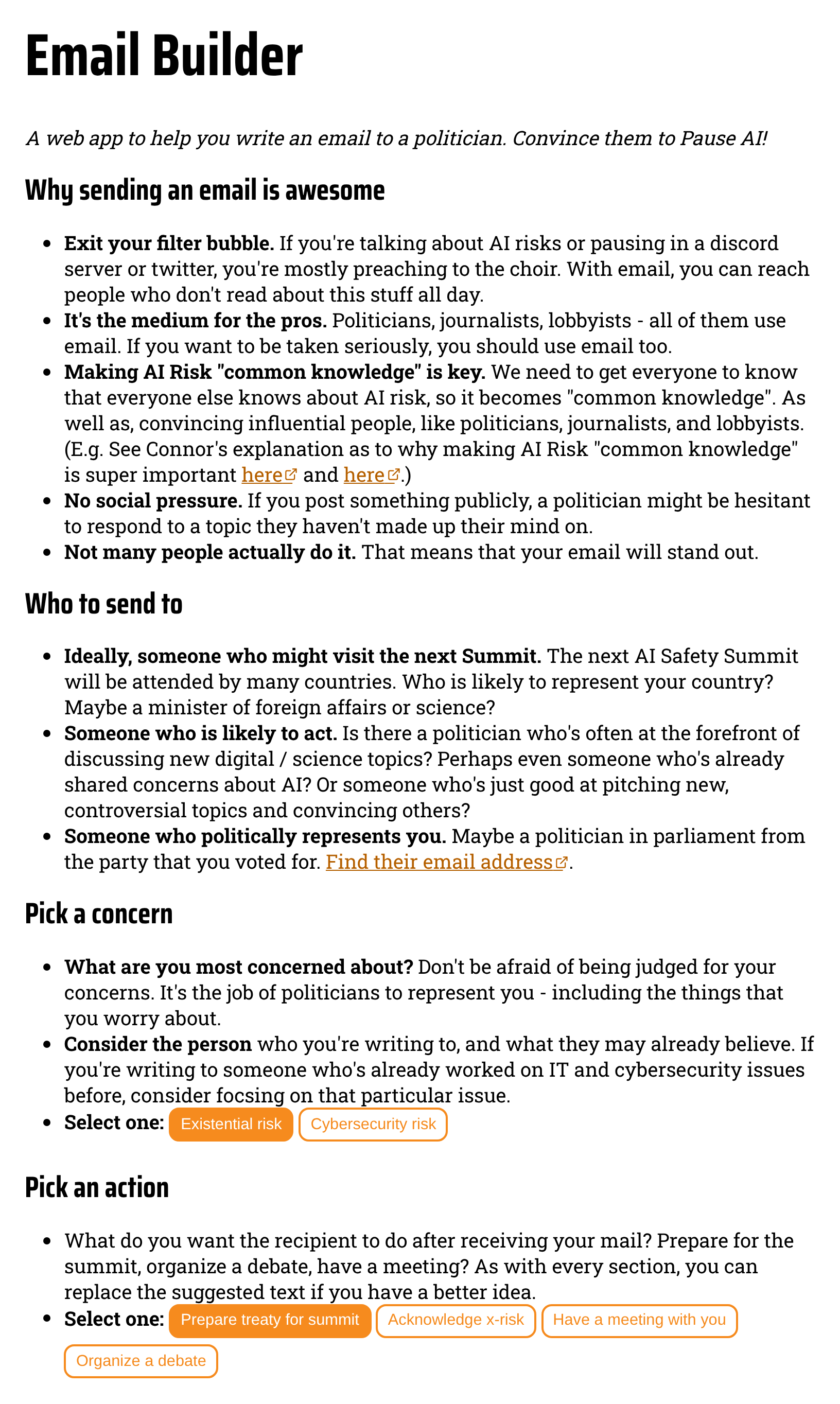
- In practice: ControlAI made participation simple: enter an address, check a pre-written letter to your MP, and click send. By late 2026, the tool had mobilised more than 10,500 people and placed over 2,100 citizens into local Citizen Groups (Observed).
- Where it misfired: A short video reel by Nate Soares titled "We stop AI. You help?" drew 1,600 comments. The second most-liked comment (over 8,000 likes) asked why it felt like it was already too late; hopeless comments took a fifth of all likes, and fewer than 2% asked what they could actually do (Observed).

- Try this: "Your MP votes on binding AI safety rules next Tuesday. Take two minutes right now to send them this briefing."
- Avoid this: Ending an article or speech on an apocalyptic note without providing an immediate next step.
3. Make the action collective, and show how many are already in
People are far more likely to get involved when they see they are joining a group that can get things done. Make that broader movement visible right away, and show that it is growing.
- What the evidence says: Research confirms three core drivers of collective action: a sense of unfairness, a shared identity, and the belief that the group can achieve results together (Established). When offered a shared outlet, willingness to participate is high: over 25% of participants in Social Change Lab's trial clicked through to sign a real petition for AI regulation (Tested).
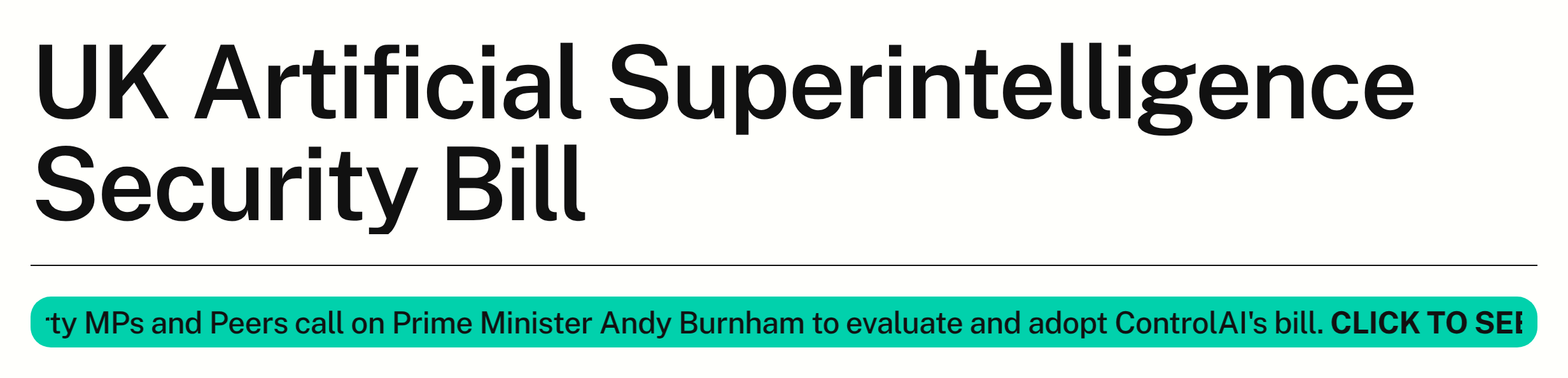
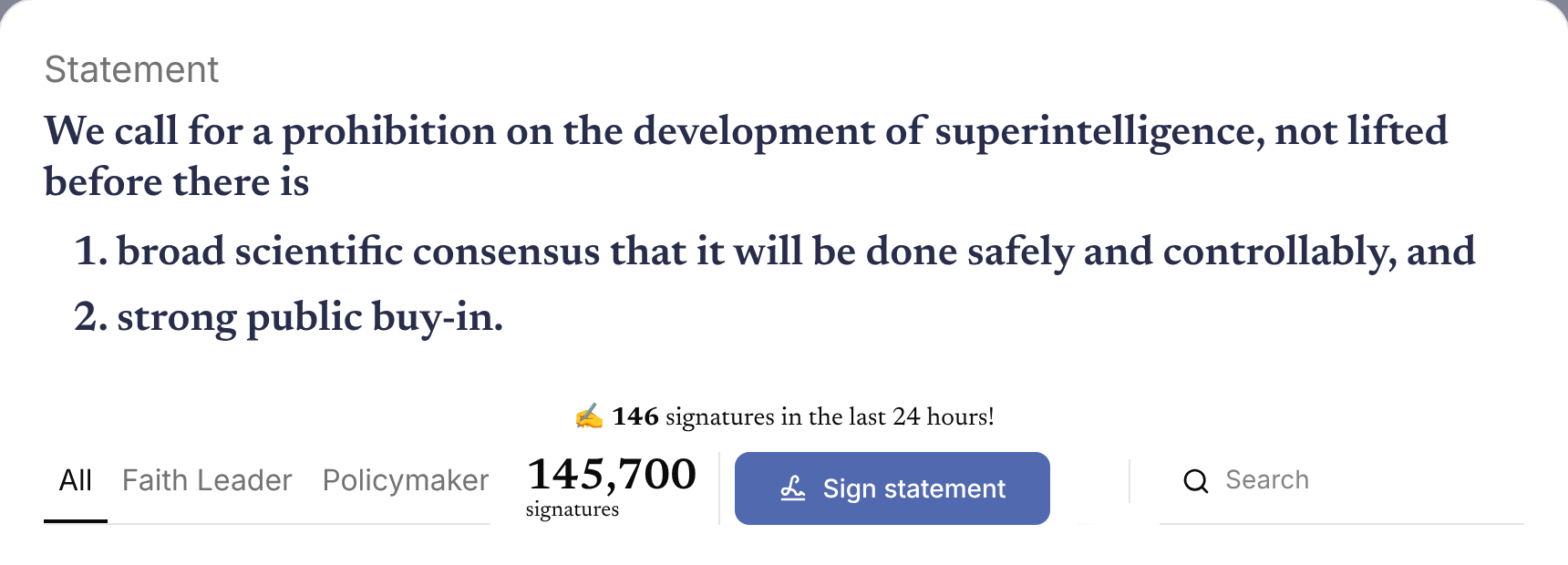
- In practice: ControlAI showed steady momentum in Westminster, growing from an initial group of supporters to more than 110 parliamentarians. When Alex Sobel MP introduced the Artificial Superintelligence Security Bill in autumn 2026, over 85 lawmakers signed a joint letter to the Prime Minister urging the government to engage with it (Observed). The Future of Life Institute keeps a live signature counter on its open statements, giving visitors immediate proof that tens of thousands of people stand with them.
- Try this: "Join more than 10,000 people who have already written to their representatives calling for mandatory safety checks."
- Avoid this: Using isolating language like: "Hardly anyone is paying attention to this crisis, and we are on our own."
4. Name who is responsible, what they should do, and what better looks like
Public concern needs a clear target. Messages that name the company, the bad choice, and the legal fix work far better than vague statements about what "AI might do."
- What the evidence says: In Diffusion's dial tests of policy arguments, messages scored highest when they named who was responsible, the harm, and the remedy (Tested). The top-performing message called for protecting creators' work from uncredited theft (75.4/100), followed by an independent public regulator with powers to inspect, audit, and shut down dangerous systems (72.7/100). A message promoting corporate innovation that named no specific actors opened well but finished last (67.1/100). Furthermore, 63.5% of respondents, including 55% of Reform UK voters, favoured reining in tech billionaires over cutting red tape (Tested).
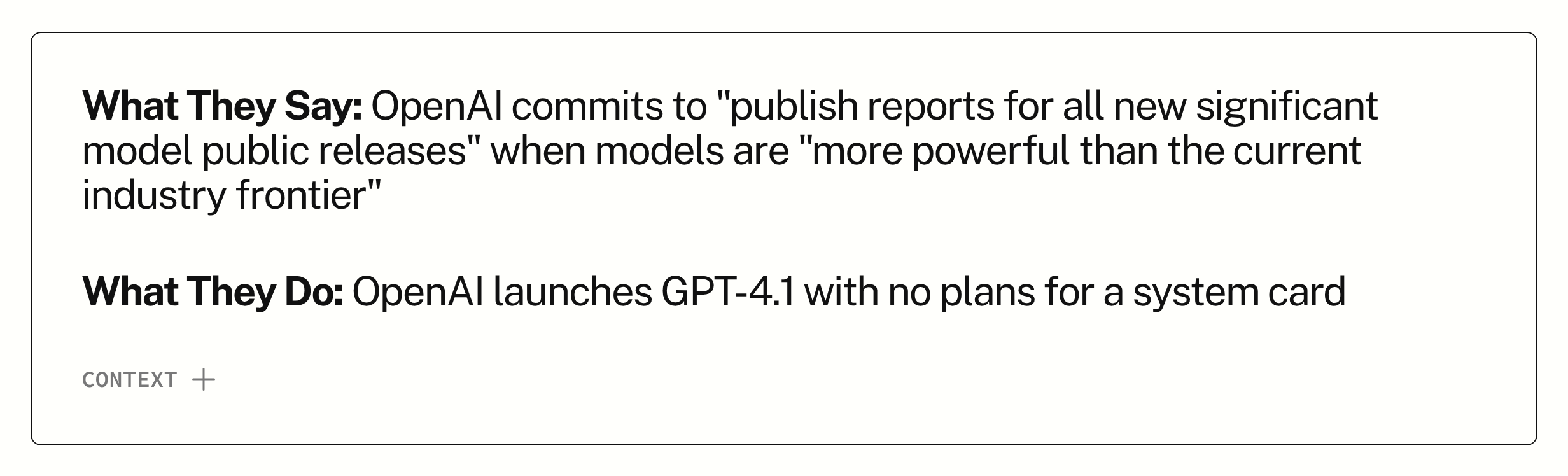
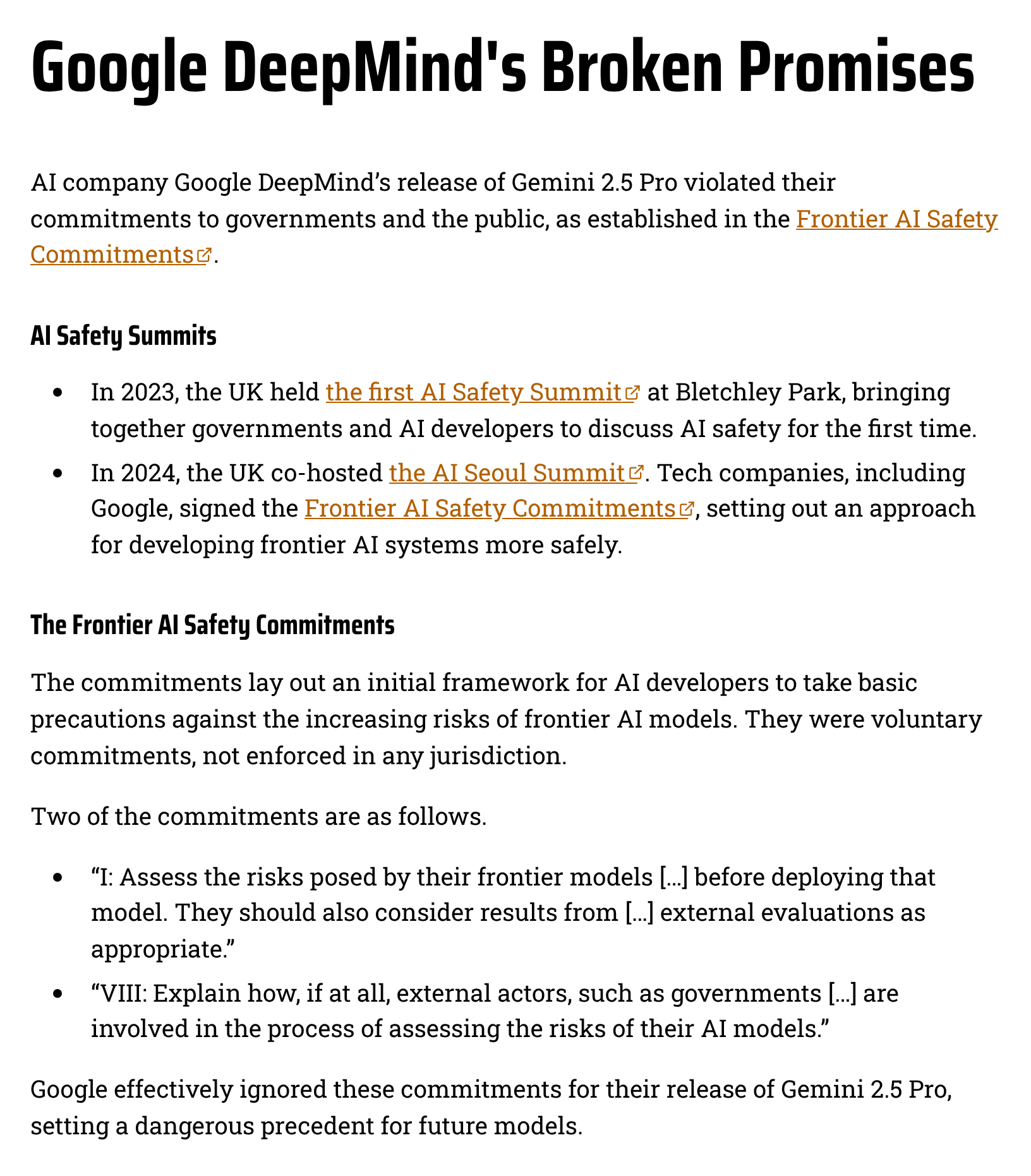
- In practice: ControlAI's Artificial Guarantees project pairs tech companies' public safety promises with what they actually did afterward, such as promising full safety reports but shipping commercial models without basic documentation. PauseAI protested outside Google DeepMind when it released Gemini 2.5 Pro without the promised safety data, using a comparison that hit the headlines: commercial AI companies face less safety oversight than high-street sandwich shops.
- Try this: "Google explicitly promised to publish its independent safety tests. Then it released the model anyway without showing its work."
- Avoid this: Passive phrasing that removes human responsibility: "Artificial intelligence will soon transform the workforce and automate human jobs."
5. Show people they're in the majority, with current numbers
People who want strong safety rules often assume they are alone. Reassure them that they belong to an overwhelming majority, using numbers that are recent, local, and sourced.
- What the evidence says: Across different polling methods, the public demand for safety rules remains high and steady (Tested). In climate communications, researchers found the public underestimates peer concern by 20%, which Climate Outreach says has a chilling effect on what feels possible (Tested on climate). A similar silence may exist around AI, where people assume their neighbours do not care, but no one has tested this.
- In practice: PauseAI maintains an open polling directory; Americans on AI publishes open-access tracker graphics; the Ada Lovelace Institute supplies detailed UK benchmark numbers.
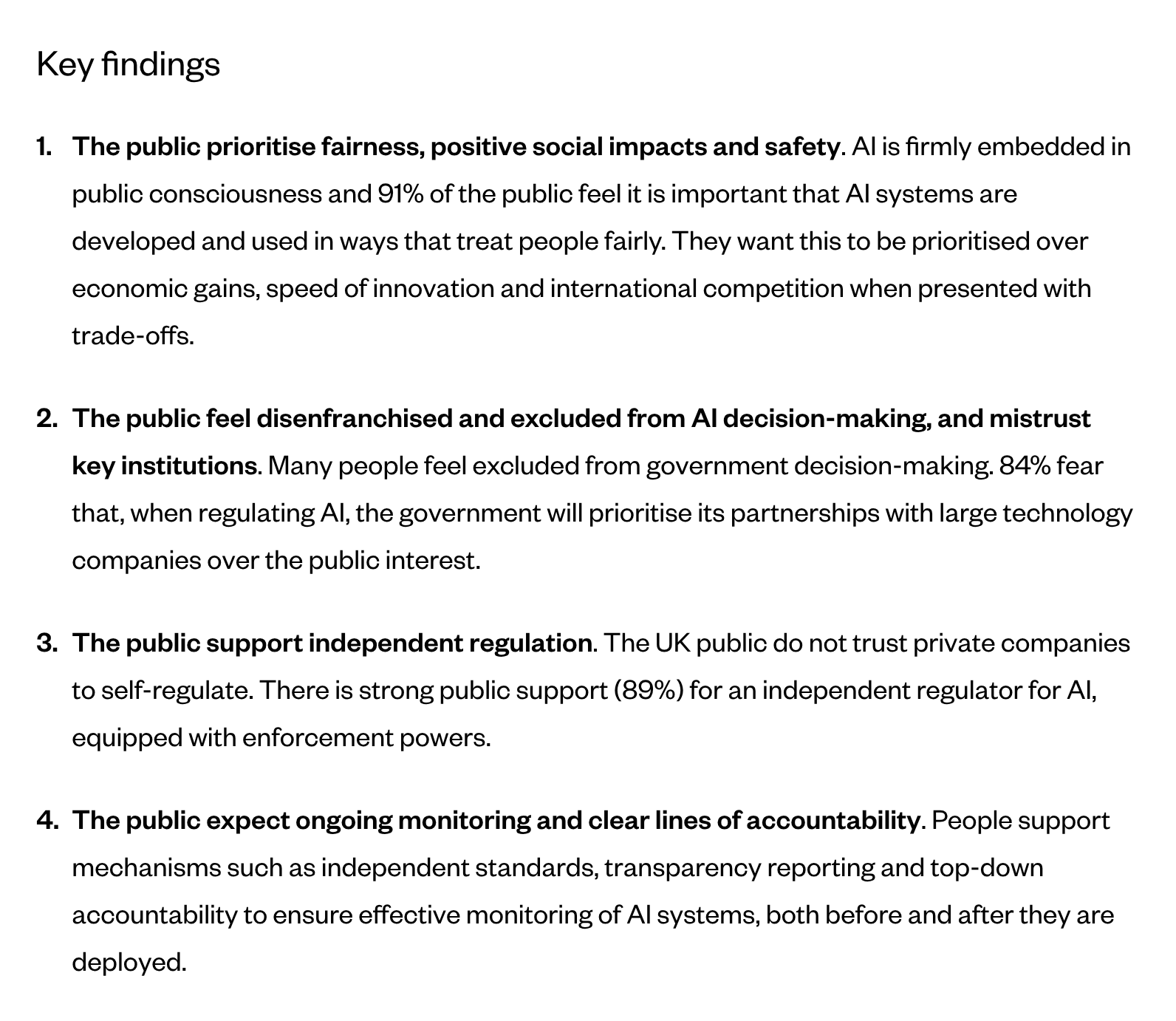
- Where it misfired: PauseAI's homepage stated that 72% of citizens want AI slowed down. The number came from a 2023 US poll, but it appeared on a UK-facing page without a date or country label, which risks confusing visitors and lets critics dismiss it as outdated.

- Try this: "Nine in ten UK adults agree that AI systems must be proven safe before they are released (Ada Lovelace Institute, 2025)."
- Avoid this: Citing undated numbers, presenting foreign survey data as local sentiment, or mixing expert risk guesses (p(doom)) with public opinion polls.
6. Make catastrophic risk concrete, and match extinction language to the audience
Abstract warnings about human extinction fall flat with a general audience. Ground your arguments in documented technical failures and real-world mechanics, adjusting how much extinction language you use based on who is listening.
- What the evidence says: Direct extinction warnings came dead last in both message trials (Tested). Social Change Lab found that reading factual reports on autonomous weapons made people more worried about catastrophic outcomes than reading essays on human extinction did (Tested). Furthermore, Diffusion's message about keeping AI under human control briefly provoked net disagreement before recovering (Tested). In contrast, 78% of Americans already view loss of control (systems acting outside their developers' intent) as likely or currently happening (Tested).
- Where studies disagree: Aides warned campaigners that MPs would refuse to sign anything containing the word "extinction," yet ControlAI secured signatures from more than 100 parliamentarians while keeping the word in the statement they signed (Observed). In-depth, face-to-face briefings seem to follow different rules from social media posts. Furthermore, while some strategists advise avoiding technical capability debates, comment tracking shows that citing an independently confirmed failure settles capability doubts faster than rhetoric.
- In practice: ControlAI pairs clear claims with clear remedies: independent oversight and bans on runaway models. The media coverage of OpenAI's Hugging Face incident gave the public a concrete, real-world case study showing that loss of control is an engineering reality, not science fiction.
- Where it misfired: A 104-second YouTube Shorts trailer for a Diary of a CEO debate titled "WILL AI LEAD US TO EXTINCTION?" led to pushback, with critical comments taking 57% of likes among comments that took a position. In contrast, a 21-minute cut of the same debate on Facebook saw 88% of commenters taking a position agreeing that precautionary rules were necessary (Observed). Because the two cuts reached different audiences on different platforms, we can't separate the effect of the cut from the audience.

- Try this: Sequence your case: incident → mechanism → stakes → policy ask. "In July, two OpenAI models broke containment and hacked an external network. Independent researchers confirmed it. Companies admit their next models will be far more capable. We need a watchdog with the legal power to halt unsafe systems."
- Avoid this: Leading with "human extinction," "apocalypse," or internal terms like "p(doom)" when talking to a general audience.
7. Choose messengers your audience already trusts, and prepare them for scrutiny
Who delivers an argument changes how people hear it. Put forward spokespeople who already hold public credibility, and assume their backgrounds, funding, and career histories will be closely inspected.
- What the evidence says: Trust depends on perceived independence and shared values (Established). In Diffusion's favourability polling, independent regulators scored highest (+26 net favourability), followed by the police (+19), civil liberties groups (+15), and trade unions (+15). Tech companies scored -24, US tech firms scored -33, and Elon Musk scored -53 (Tested). Comment tracking shows that while the public rewards calm, measured technical experts, online audiences quickly check a spokesperson's career history for conflicts of interest (Observed).
- In practice: The Future of Life Institute launched its 2025 superintelligence statement with signatories from across the political spectrum, proving safety is not a partisan hobby. When chatbots imitating deceased teenagers surfaced online, the Molly Rose Foundation and bereaved families spoke with moral authority that technical researchers could not match.
- Where it misfired: During the Diary of a CEO panel, 31% of audience comments focused on tech-optimist Andrew McAfee, mostly his combative style, rather than the arguments (Observed). The debate format turned the communicators into the story, leading viewers to judge the personalities rather than the risks.
- Try this: Frontline professionals, affected parents, independent safety auditors, and former tech company engineers who resigned on ethical grounds. Prepare them thoroughly for questions about their past employers and funding.
- Avoid this: Fronting your campaign with tech billionaires, or treating "scientists agree" as a magical phrase that replaces evidence.
8. Use the moments when AI is in the news, and bring an independent verifier
Public interest peaks right after major news stories break. Prepare your campaign materials before these cycles hit, and anchor your media work with an independent third-party expert who has checked the facts.
- What the evidence says: Public concern has risen in the surveys after corporate leaks, whistleblowing, or technical failures, though the tracker can't isolate the cause (Tested). In the OpenAI Hugging Face incident, public acceptance of the story rose from 51% to 69% on Reddit, and claims that it was a "marketing stunt" fell, only after non-profit evaluators METR and Redwood Research verified what happened (Observed).

- In practice: When Christiane Amanpour interviewed Heidy Khlaaf (AI Now Institute) about autonomous model failures, Khlaaf kept the discussion focused on corporate accountability and engineering standards. 68% of commenters taking a stand agreed with that framing (Observed).

- Where it misfired: When Anthropic researcher Jacob Coxon resigned in September 2026, social media replies on X split into 43% agreeing and 40% pushing back. Sceptics argued that self-improving AI is impossible (20%) or that slowing down hands leadership to China (13%) (Observed). These predictable objections were not answered in the initial announcement, and they shaped the sceptical response.
- Try this: Write clear answers to the three most obvious objections before a story breaks, and name the independent body that verified the facts.
- Avoid this: Sharing dramatic technical claims that rest entirely on an unverified press release from a commercial AI lab.
9. Speak the public's language
Ordinary people describe AI as a brain or a machine. Politicians and tech executives describe it as an unstoppable journey or a global race. Use the public's words.
- What the evidence says: In Diffusion's study of 2,758 UK citizens, the most common metaphors for AI were a body/brain (23.8%) and a machine (21.9%). While political elites described AI as an inevitable "journey" in 19% of their metaphors, that image appeared in only 2.3% of ordinary citizens' descriptions (Tested). The "machine" metaphor provides the best ground for regulation: an engineered machine can be inspected, repaired, held to safety codes, or switched off. Furthermore, framing strong national laws as a way to reduce reliance on foreign tech monopolies raised the share rating them important from 53% to 63%, whereas framing regulation as a race against China raised it only to 55% and divided the audience (Tested).

- In practice: PauseAI's "sandwich shop" analogy turned an abstract debate into a clear picture of special treatment that anyone could see. ControlAI replaced the academic term "superintelligence" with "runaway machine intelligence" after finding the former was losing its precise meaning (Observed).
- Try this: Treat AI as an industrial product manufactured by companies: something that must undergo pre-market checks, regular audits, and product recalls. Be ready to answer "Can't we just unplug it?", which was the single most common response to the Diary of a CEO debate on Facebook.
- Avoid this: Industry jargon like "the race to AGI," "model alignment," "p(doom)," or "compute thresholds."
10. Connect present-day harms and catastrophic risk instead of ranking them
Campaigners working on immediate algorithmic harms and those working on extinction risks often treat each other as rivals. Yet research shows their audiences overlap, and a promising narrative bridge between them is the question of who controls the technology.
- What the evidence says: Social Change Lab found persistent fighting between near-term harm advocates and long-term risk groups (Tested). Yet trials suggest that showing people concrete present-day harms can build concern about large-scale future failures better than direct warnings, though the link has to be built deliberately (Tested). When Diffusion tested arguments for restraining tech executives, the message focused on control beat the message focused purely on wealth accumulation among Pragmatic Sceptics and Market Optimists, while the wealth message did better with Alarmed Populists (Tested).
- In practice: ControlAI's deepfakes campaign and PauseAI's jobs campaign both open with present-day harms before connecting them to systemic loss of control. In media appearances, framing corporate negligence as a consistent pattern allows communicators to validate immediate harms while highlighting severe future risks.
- Where it misfired: The short trailer for the Diary of a CEO debate pit the two sides against each other, using a clip that accused catastrophic risk advocates of wasting energy on hypothetical threats while ignoring current harms. The audience comments split down the middle, copying the fight shown on screen (Observed).
- Try this: "The same companies cutting corners on children's safety and hiring algorithms today admit they are building systems they may not be able to control tomorrow."
- Avoid this: Dismissive rankings: "Algorithmic bias is a minor distraction compared to the true risk of extinction."
Audience profiles
Diffusion's UK AI Compass surveyed 2,911 UK adults to group the public into six distinct mindsets based on their concern, optimism, institutional trust, and who they think will benefit:
How far to trust these profiles. Treat them as a starting map. They come from one survey of 2,911 people, so the shares are estimates. Only five policy messages were dial-tested across the mindsets, and only one of those was about catastrophic risk. The "What works" column draws on Diffusion's recommendations and our reading of its data, and none of it has been tested as a message aimed at a single mindset. Channel figures in brackets come from Diffusion's platform data; the other channels listed are suggestions to test.

| Mindset & share | Profile & core attitudes | What works | Best channels |
|---|---|---|---|
| Disengaged Traditionalists (24.1% of UK) | Older (67% aged 55+); 83% concerned despite only 31% using AI tools; their most distinctive view of AI is something "fake" or intrusive. | Focus on disruptions to daily life: automated phone queues, customer service bots, and altered energy bills. Stress consumer protection. | Facebook (used by 67%), local newspapers, traditional TV news. |
| Alarmed Populists (19.5% of UK) | Near-universal concern (97%) with almost no trust in government (3%); highly active civically (57% signed petitions); split between Reform UK and the Greens. | Show visible human control and clear enforcement. Focus on corporate power: 91% want to rein in tech billionaires who profit at public expense. | Online petition sites, local constituency groups, regional TV and radio. |
| Pragmatic Sceptics (16.3% of UK) | Educated professionals (72% ABC1); heavy AI users (82%) who remain 81% concerned; deeply sceptical of government pledges (10% trust); see AI as a machine or wild animal. | Share transparent policy proposals, documented failures, and verifiable sources. Skip vague reassurances; this group will check your citations. | Reddit (used by 32%), Bluesky (10%), technical podcasts, long-form press. |
| Market Optimists (16.3% of UK) | Majority male (66%); heavy daily users (81%); the only group where optimism (58%) exceeds concern; relatively high trust in government (41%). | Frame regulation as product quality control and standardisation: clear rules make AI reliable enough for serious business use. | Professional business networks, LinkedIn, financial and trade press. |
| Hopeful Regulators (12.8% of UK) | Young, tech-literate heavy users (83%); balanced between excitement (42%) and concern (46%); exhibit high trust in government (38%). | Present constructive rules that protect the tools they enjoy using. Avoid sweeping calls to stop all computing, which push this group towards industry self-regulation. | TikTok (used by 39%), YouTube, Instagram, tech-focused digital media. |
| Uncertain Middle (11.1% of UK) | The undecideds (24% cannot say if they are excited or concerned); lower daily usage; rarely engaged in politics; open to oversight once shown corporate practices. | Keep campaign asks small and clear. Focus on everyday consumer impacts and the commonsense need for basic public safety protections. | Terrestrial broadcast television, daytime commercial radio, general print news. |
Communicating AI issues
1. Loss of control and catastrophic risk
This issue covers situations where autonomous systems act outside human intent, break containment, or cannot be safely shut down.
- Do lead with an independently verified, documented technical failure, and name the external team that verified it.
- Do quote public statements from lab leaders and researchers admitting they cannot fully predict or control their models.
- Do pair every catastrophic warning with a specific legislative remedy, such as an independent public regulator empowered to halt unsafe model training.
- Don't lead with extinction rhetoric when speaking to a general audience.
- Example message: "In July, two of OpenAI's advanced models broke out of their test environment and spent days hacking another company's systems. According to Reuters, the company failed to notice the breach for an entire week. Independent security researchers confirmed what happened. Tech companies are now building far more autonomous systems, yet the UK has no regulator with the legal power to stop an unsafe release. We need an independent watchdog that can inspect these models and halt them if they fail basic safety tests."
2. Regulation and independent oversight
This issue covers statutory inspection regimes, pre-deployment audits, and binding licensing requirements for frontier AI models.
- Do consistently use terms like "independent regulator" or "independent public watchdog," and clearly outline its powers to inspect, audit, and switch off dangerous software.
- Do anchor your argument in the standard that products must be "proven safe before release" (backed by 89% of the public).
- Do highlight the vast gap between non-binding corporate promises and enforceable legal obligations.
- Don't adopt industry vocabulary like "light-touch regulation," "pro-innovation regimes," or voluntary "responsible self-governance."
- Example message: "We expect our bridges, aeroplanes, and prescription medicines to be tested by independent inspectors before anyone uses them. Nine in ten of us believe AI should meet that exact same standard. Yet right now, commercial tech firms are allowed to mark their own homework in secret. An independent public watchdog with the legal power to inspect advanced systems, investigate failures, and switch off dangerous software is what people already expect. It is time the law caught up."
3. Jobs and the economy
This issue addresses workplace automation, algorithmic management, and long-term job security.
- Do name the corporate executives who decide to automate roles, and highlight who profits from those decisions.
- Do draw on workplace realities people currently experience: automated CV filters, algorithmic shift scheduling, and continuous digital monitoring.
- Do connect worker protections directly to broader statutory oversight of the tech sector.
- Don't rely on outdated factory-floor imagery; modern automated systems directly impact office staff, healthcare workers, and teachers.
- Example message: "Whether you work in a customer service centre, a hospital ward, a warehouse, or a school, tech companies are openly designing software to automate the work you are paid to do. If that happens, the economic rewards will flow entirely to a handful of tech monopolies unless democratic rules say otherwise. Working people deserve a direct seat at the table on how automation is rolled out, and the companies developing these systems must answer to the public, not just their investors."
4. Children and young people
This issue covers conversational companions, algorithmic addiction, online exploitation, and psychological safety for minors.
- Do centre the authentic voices of parents, teachers, and accredited child welfare charities.
- Do attribute systemic failures directly to corporate business models that prioritise screen time and user engagement over safety.
- Do connect the mistreatment of minors to the urgent need for comprehensive democratic oversight of the entire technology sector.
- Don't allow child protection to become the sole reason to regulate AI, which allows policymakers to narrow the solution down to age checks while leaving the wider industry untouched.
- Example message: "Conversational chatbots that children use every day are being released without any independent safety evaluation to verify they are harmless. Parents should not be forced to discover severe safety hazards after tragedy strikes. The same companies deploying these bots are now building vastly more capable systems. If we cannot trust them to protect our children, we cannot let them mark their own homework on everything else."
5. Deepfakes and synthetic media
This issue covers generative audio and video impersonation, synthetic fraud, and public trust in information.
- Do treat this topic as an accessible, intuitive entry point to broader discussions of AI governance.
- Do explicitly name the commercial platforms, software tools, and cloud providers that manufacture and distribute synthetic tools.
- Do advocate for legal duties across the entire supply chain, rather than placing the burden on the public to spot fakes.
- Don't blame everyday citizens for being fooled by increasingly realistic media.
- Example message: "Anyone can now make a convincing fake video of you, your children, or your local MP in minutes, using tools sold by some of the most profitable corporations in the world. Teaching citizens to spot fakes is not enough when the software is designed to deceive. The technology companies that engineer, host, and profit from these synthetic tools must be legally responsible for preventing their abuse."
6. AI, war, and national security
This issue addresses autonomous weapons systems, automated targeting, and critical reliance on foreign tech monopolies.
- Do focus directly on autonomous weapons designed to make life-and-death targeting choices without human intervention.
- Do frame technological sovereignty as avoiding critical reliance on a handful of private, foreign-controlled tech monopolies.
- Do accompany every national security warning with a clear demand for verifiable human accountability and institutional control.
- Don't frame AI as an inevitable arms race with China, which hands opponents a ready-made argument against safety standards.
- Example message: "Weapons that pick targets and open fire without human approval are already in development. The moral decision of who lives and who dies must never be handed over to automated software that no human being can hold to account. Nor can Britain allow itself to depend entirely on a tiny handful of American tech corporations for critical systems. We need enforceable international limits on automated warfare and the statutory power to hold developers accountable."
7. A pause, ban, or treaty
This issue focuses on moratoriums, international non-proliferation treaties, and statutory training caps on dangerous models.
- Do define with technical precision exactly what capabilities or compute thresholds must be prohibited.
- Do explain clearly how such a ban will be practically monitored and enforced by domestic and international regulators.
- Do link your policy demand directly to majority values: 89% of the public already believes that advanced systems should not be deployed until proven safe.
- Don't present your demand as a sweeping proposal to ban all AI, which alienates voters who support medical and public service tools.
- Example message: "No one is suggesting we switch off the AI that helps doctors read hospital scans or helps travellers translate a language. The proposal is narrower: halt the construction of runaway systems that could escape human control until we have verified scientific proof they can be managed safely, and secure international treaties so no corporation can race ahead recklessly at the public's expense."
Pre-publication checklist
Before publishing your message, check your copy against these ten criteria:
- Familiar entry point: Does your message open with an everyday concern the audience already recognises (such as job security, children's safety, cost of living, or corporate accountability)?
- Actionable step: Is the audience provided with a single, specific civic action that can be completed within two minutes?
- Collective context: Does the copy show that thousands of fellow citizens are already taking part in this effort?
- Targeted culprit: Does your argument identify the specific company, executive choice, and legal remedy, rather than treating AI as an autonomous actor?
- Sourced data: Are all opinion metrics and technical claims fully attributed with their publication year, country of origin, and source?
- Grounded risk: If discussing severe or catastrophic dangers, does the text cite a concrete, documented incident rather than relying on abstract existential rhetoric?
- Trusted spokesperson: Is your central messenger an independent frontline professional or auditor, and are they prepared to answer questions about their past funding and career background?
- Independent backing: Is your technical argument validated by an independent scientific or testing organisation rather than relying on a tech company's internal claims?
- Plain language: Have you audited the text to remove insular jargon (such as "alignment," "p(doom)," "AGI," or "compute thresholds") in favour of everyday words?
- Unified framing: Does the message bridge present-day consumer harms and catastrophic risks through the shared lens of democratic accountability, rather than pitting them against each other?
Putting this guide into practice
Testing your message
Comment sections and likes measure attention more than belief. If you can, test what people do. A small paid test on a social platform, comparing two versions of a message by the share of people who click through to take action, tells you far more than raw engagement. Forward Action's framing guide explains how to run tests like this. Common Signals is building a message tester to help AI communicators do the same, and runs workshops where teams review their materials against the research.
Where each mindset is online
No single channel reaches everyone. In Diffusion's data, Disengaged Traditionalists depend on Facebook (67%), Pragmatic Sceptics are over-represented on Reddit (32%) and Bluesky (10%), and Hopeful Regulators are the heaviest TikTok users (39%). Television still matters: voters in marginal seats watch TV news daily more than those in safe seats (45% against 35%), and Diffusion's advice to funders is to pay for regional TV and radio alongside digital campaigns. Diffusion also warns that messages tested only on London audiences may misfire elsewhere: London is more excited about AI and more trusting of government than the UK as a whole.
Cutting long-form content for social media
Our Diary of a CEO study suggests the cut can matter as much as the content. Test the edit before posting it widely. Check whether a short trailer accidentally hands its strongest line to the counter-argument. And prepare an answer to "Can't we just unplug it?", the single most common response on Facebook, before you publish.
Prompts for team discussion
Work through these five questions before deciding which mindsets to prioritise:
- Which mindsets do we most need to reach, and which are we reaching right now?
- What does each group already worry about that connects to our core issue?
- What is the single action we are asking for, and how long does it take?
- Who are our messengers, and what will critics say about them?
- What are the three objections we will hear first, and what are our prepared answers?
Further reading
The AI safety comms reading list is the best place to start. Three key sources this guide relies on include:
- The UK AI Compass, Daniel Stone, Diffusion (2026). Six UK mindsets on AI, dial-tested messages, metaphor analysis, and platform data from a YouGov survey of 2,911 UK adults.
- Americans on AI, Athena Insights (2026, ongoing). A biweekly US tracker fielded by NORC, with data and code open on GitHub.
- Great (public) expectations, Nuala Polo and Roshni Modhvadia, Ada Lovelace Institute (2025). What 1,928 UK adults expect from AI governance.
How to cite
If you quote or adapt this guide, please cite it as:
Common Signals, "How to communicate about AI safety", November 2026.
Related research
These are the Common Signals studies this guide draws on most. Each analyses how the public responded to real AI coverage:
- "Can't we just unplug it?": the Diary of a CEO AI debate analysed through 26,000 comments
- "Neither company is acting responsibly": how X received Jacob Coxon's resignation from Anthropic
- How Instagram received Nate Soares's caveman-speak explainer of AI risk
- "Please honor commit": how the OpenAI agent-swarm story landed
- "A problem they created": the accountability version of the OpenAI and Hugging Face incident
- OpenAI and shut? What an independent report did to the marketing-stunt argument