Who this article is for
AI communicators deciding how to frame existential-risk messages, and researchers designing message tests across audience segments.
Key findings
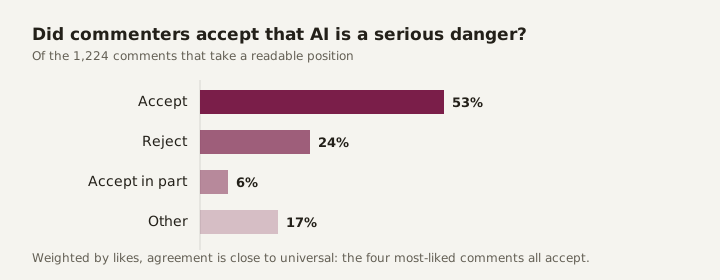
- Of the 1,224 comments taking a readable position, 53% accepted that AI is a serious danger, 24% rejected it and 6% accepted part of the argument.
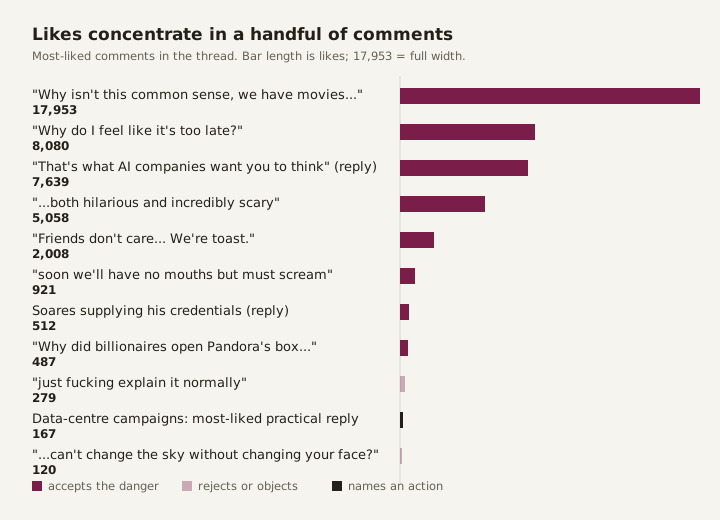
- Weighted by likes, agreement was close to universal. The four most-liked comments all sided with the video and took three-quarters of all likes.
- The commonest response among believers was resignation. "Why do I feel like it's too late?" was the second most-liked comment.
- Sceptics mostly doubted that AI is capable of this (two in five) or objected to treating AI as an agent when companies are responsible (one in five).
- Sci-fi references appeared in one comment in nine and took 38% of likes. Believers used them as shorthand for the danger, sceptics as shorthand for fiction.
- Blaming the companies was the one frame both sides used.
The reel
On 4 August 2026 Nate Soares, president of MIRI and co-author of If Anyone Builds It, Everyone Dies, posted a one-minute reel to Instagram titled "We stop AI. You help?". It makes the case for AI existential risk in deliberately stripped-down "caveman" English: AI is getting "big big big smart", AI has its own goals, a smart AI builds its own technology and doesn't need humans, some AIs have already tried to escape, and leaders know and don't care. It ends: "Tell your friends. We stop AI."
By the end of August the reel had 78,000 likes and 1,703 comments, a large audience for an argument that usually circulates inside the AI-safety field.
How we did it
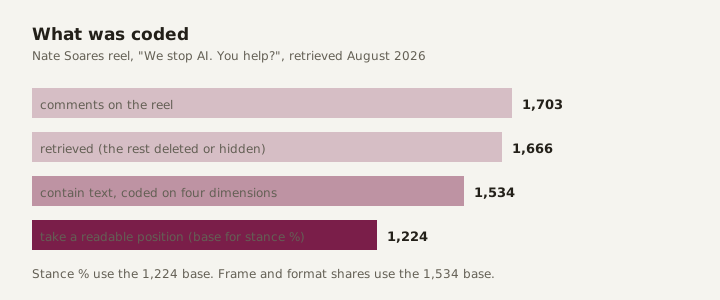
On 29 August we retrieved 1,666 of the 1,703 comments (the rest were deleted or hidden) and removed usernames. A language model coded the 1,534 comments with text for stance, frame, reaction to format and emotion, in a single pass without a second coder. A second, larger capture in September, described below, was spot-checked by Ben Matthews.
Limits: this is one video from one messenger, shown to whoever Instagram's algorithm chose. Likes are concentrated on a few comments, comment sections over-represent strong reactions, and likes measure attention rather than persuasion.
Too late
The most-liked comment, with 17,953 likes, is "Why isn't this common sense, we have movies about this since forever". The second, with 8,080, is "Why do I feel like it's too late?". Between them they describe the audience the reel found: people who already believed something like this and had nowhere to put that belief.
Among comments accepting the premise, resignation was as common as anger and more common than fear. Fatalistic comments were few but took a fifth of all likes. Almost nobody said they would share the video.
"Friends don't care. Friends say 'too late, friend like dumb AI pictures and convenience'. Leaders don't care. Leaders love money too much. We're toast."Instagram comment, 2,008 likes
Kim Witte's research on fear appeals predicts this. A strong threat with no credible way to act on it tends to produce avoidance instead of action.
The few comments that pushed back on despair named something concrete that was already happening:
"It's not!! These companies are relying on data centres getting built but they're getting blocked and campaigned against everywhere!! Don't let their propaganda convince u to despair."Instagram reply, 167 likes
That was the most-liked practical comment in the thread.
Sci-fi as shorthand, for both sides
About one comment in nine used a film or book as its main frame: The Matrix, then Terminator, Skynet, Ultron and Harlan Ellison's I Have No Mouth and I Must Scream. Most of these commenters accepted the danger. The reel didn't need to explain the argument to them, only name it.
"soon we'll have no mouths but must scream"Instagram comment, 921 likes
Sceptics used the same references to mean "this is fiction":
"Please stop watching terminator"Instagram comment
"We don't need to talk about AI like it walked out of a sci-fi story to prove it's flawed? Who is this convincing?"Instagram comment
A comment thread can't tell us which audiences go which way. A segmented message test can, and it's one of the first things we plan to run.
Two objections
Two in five sceptics doubted that AI could do what the reel described. The AI they've used writes poor essays and can't edit a photo properly.
"So Ai can commit serious worldwide crimes and create an Ai world but it cannot change the sky of your picture without changing your whole face? Mhmmm"Instagram comment, 120 likes
"I need evidence, than a retelling of the news highlights."Instagram comment, 56 likes
The reel says AIs have tried to escape and deceive without showing any evidence, so these viewers had nothing to go on.
One in five objected to AI being presented as an agent with goals:
"personifying AI takes out the responsability of the companies, is it clear now? AI doesn't do anything it cannot do."Instagram reply, 117 likes
This is a familiar position among people focused on AI's present-day harms, and the reel's framing pushed them away.
Blaming the companies
Most frames sat on one side. Fatalism and sci-fi belonged to believers, capability doubts to sceptics. Blaming the companies was used by both. Well over a hundred comments put AI companies, tech billionaires or named executives at the centre of their argument.
"Why did a handful of billionaires open Pandora's box and we just all went with it"Instagram comment, 487 likes
"AI not commit crime but AI controlled by big people, big people misuse AI"Instagram comment
The most-liked reply in the thread took the same line against the fatalists: "That's what the AI companies want you to think" (7,639 likes).
People worried about catastrophic AI risk and people worried about present-day harms rarely share a message. In this thread, blaming the companies was where they already agreed. It's the frame we most want to test across audience segments.
The format
Some comments mocked the caveman register, slightly more praised it, and about one in seven imitated it. The imitators accepted the claim at close to the same rate as everyone else.
"I like that you simpified the wording of this for ai thinkers"Instagram comment, 488 likes
"just fucking explain it normally"Instagram comment, 279 likes, 36 replies
The fourth most-liked comment captures both reactions: "The fact that it needs to be explained in this way is both hilarious and incredibly scary" (5,058 likes).
The cost was that one comment in seven talked about the delivery instead of the argument.
The messenger
About 1% of comments mentioned the book, MIRI or who Soares is. The reel shows no sign of his expertise, and the audience treated it as content from a stranger. Soares eventually replied to a sceptic himself:
"okay. my book is called 'if anyone builds it, everyone dies.' it's an nyt bestseller."Nate Soares, replying in the thread, 512 likes
That reply got more likes than almost any other comment in the thread. His credentials helped, but he had to supply them after the fact.
A second capture
On 17 September 2026 we captured 2,136 of the reel's 2,715 comments, using a method that can't see like counts, and recoded them against a redrafted frame list. Ben Matthews spot-checked a random 40 and agreed with all 40.
Several findings held almost exactly. Mentions of Soares, MIRI or the book were 1% both times. Near-term harms such as water and energy use were 3% both times. Mentions of leaders or government policy were 5% then and 6% now. Imitators of the caveman register accepted the claim at 47% then and 46% now.
Stance moved towards the middle: 60% agreed, 19% disagreed and 20% were mixed. The two captures used different frame lists and definitions of "mixed", so read this as the same reception measured a second way. Figures based on likes rest on the first capture only.
What communicators can take from this
- Most of this audience didn't need convincing that AI could be dangerous. What they lacked was something to do. Give a persuaded audience a concrete step, or expect resignation.
- Answer the two objections directly: show evidence of what AI can already do, and say who is responsible.
- Consider leading with the companies. It was the one frame both sides used.
- Say who you are on screen. The thread rewarded credentials and evidence whenever they appeared.
Data
The coded dataset and codebook are at commonsignals.org/data/soares-reel-2026-08/.
Other studies in the series: the Dwarkesh episode, the Amanpour segment, the METR report and the Coxon resignation thread.
Disclosure
An LLM was used to structure and review this article, with the first and final edits made by a human.