Who this article is for
AI communicators deciding how to frame existential-risk messages, and researchers designing message tests across audience segments.
TL;DR
- Sceptics did not say AI is harmless. Two in five said today's AI is too flawed for the danger to be real; one in five objected to personifying AI when companies are responsible.
- "Blame the companies" was the one frame believers and sceptics used alike. It is the bridging frame we most want to test.
- Science fiction was the way in for believers and the way out for sceptics, and carried 38% of all likes.
- The most visible response was resignation. "Too late" is the second most-liked comment, and the call to action barely registered.
- Most commenters accepted the premise: 53% of those taking a position agreed AI is a serious danger.
Introduction: Tell your friends. We stop AI.
On 4 August 2026, Nate Soares, president of the Machine Intelligence Research Institute and co-author of If Anyone Builds It, Everyone Dies, posted a one‑minute reel to Instagram titled "We stop AI. You help?". It makes the case for AI existential risk in deliberately stripped-down "caveman" English: AI is getting "big big big smart", AI has its own goals, a smart AI builds its own technology and does not need humans, some AIs have already tried to escape, leaders know and do not care. Posted on 4 August 2026, the reel had 78,192 likes and 1,703 comments when we captured it on 29 August.
Tell your friends. We stop AI.
That is an unusually large audience for a message that normally circulates inside the AI‑safety field.
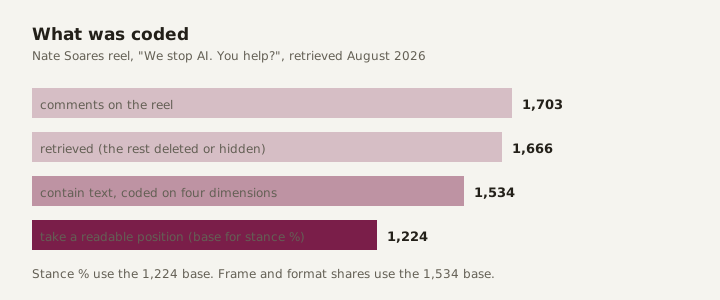
To get a handle on how that message landed outside the field, we ran a rapid analysis of the comment thread. We retrieved 1,666 of the 1,703 comments (the rest are deleted or hidden), removed usernames, and coded the 1,534 that contain text on four dimensions: whether the commenter accepted or rejected the video's claim, the dominant frame they used, how they reacted to the format, and the emotional register of the comment.
Did the existential‑risk argument get through? And where it didn't, what got in the way?
Method
Of 1,703 comments on the reel, 1,666 were retrieved (the rest deleted or hidden); 1,534 contained text and were coded on four dimensions: stance, dominant frame, reaction to the format, and emotional register. Stance percentages use the 1,224 comments with a readable position as their base; frame, format and register shares use the 1,534 base.
Comment threads are self-selected and unrepresentative of any population, and likes measure salience, not persuasion.
Comments are quoted verbatim but not attributed to usernames, in line with research-ethics guidance on social-media data; the reel's author is named because he published it.
The numbers
Most commenters accepted the premise. Of the 1,224 comments that take a readable position, 53% accept that AI is a serious danger, 24% reject it and 6% accept part of the argument.
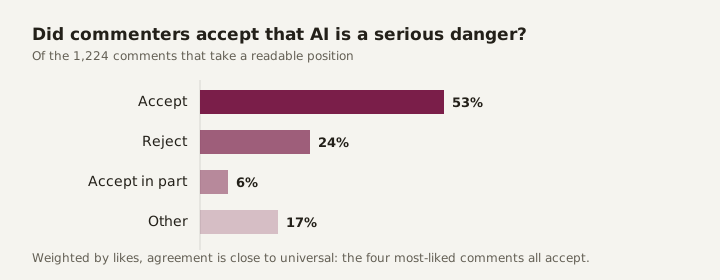
Weighted by likes, agreement is close to universal: the four most‑liked comments all side with the video and between them carry three-quarters of every like in the thread.
But agreement did not turn into action. The video asks viewers to tell their friends and help stop AI. Only a handful of comments ask what they should do.
The dominant response among those who accepted the argument was resignation: "too late" is the second most‑liked comment in the thread, and fatalistic comments, though few, attract a fifth of all the likes in the thread.
The rejection had a specific shape. Sceptics were not saying AI is harmless.
Two in five said current AI is too flawed or too hyped for the danger to be real, and one in five objected to AI being personified as an agent when the companies building it are the ones responsible.
Science fiction was both the way in and the way out. One comment in nine reached for a film or book, and those comments carry 38% of all likes.
The same schema that gave believers instant comprehension gave sceptics an instant dismissal.
One frame was shared by both sides. "Blame the companies" was used by believers, sceptics and the people trying to reconcile the two. It is the one place in the thread where audiences that normally talk past each other stand together.
Salience and resignation
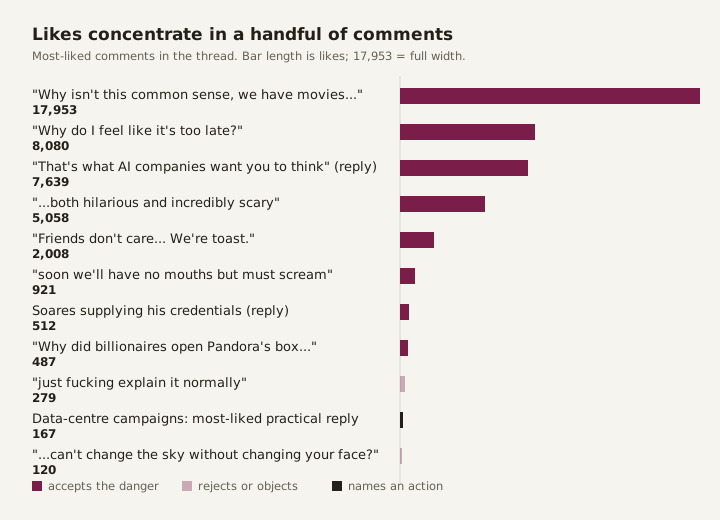
The most‑liked comment in the thread, with 17,953 likes, is "Why isn't this common sense, we have movies about this since forever". The second, with 8,080, is "Why do I feel like it's too late?".
Between them they describe the audience the video found: people who already believed something like this and had nowhere to put that belief.
Among comments that accept the premise, resignation is as common as anger and more common than fear. "We're toast" has 2,008 likes.
"Friends don't care. Friends say 'too late, friend like dumb AI pictures and convenience'. Leaders don't care. Leaders love money too much. We're toast." Instagram comment, 2,008 likes
A threat message with no credible route to efficacy tends to demobilise the people it persuades, and the thread shows that pattern almost exactly.
The few comments that pushed back on despair did so by naming something concrete and already happening:
"It's not!! These companies are relying on data centres getting built but they're getting blocked and campaigned against everywhere!! Don't let their propaganda convince u to despair." Instagram reply, 167 likes
That reply is the most‑liked practical comment in the thread. Efficacy, where it appeared, was rewarded. It just rarely appeared.
Science fiction: a way in, and a way out
Around one comment in nine uses a film or a book as its main frame. The Matrix leads, then Terminator, followed by Skynet, Ultron and Harlan Ellison's I Have No Mouth and I Must Scream.
The great majority of these commenters accept the danger. For these viewers, the video did not need to explain the argument; it only needed to name it.
"soon we'll have no mouths but must scream" Instagram comment, 921 likes
But the same references were the sceptics' shorthand for "this is fiction":
"Please stop watching terminator" Instagram comment
"We don't need to talk about AI like it walked out of a sci‑fi story to prove it's flawed? Who is this convincing?" Instagram comment
Whether a cultural reference helps or hurts almost certainly depends on who is listening.
Capability and personification: the two objections
The largest group of sceptics, around two in five, rejected the argument on capability grounds.
The AI they have used writes poor essays and cannot edit a photo, so the claim that it could escape or deceive reads as hype.
"So Ai can commit serious worldwide crimes and create an Ai world but it cannot change the sky of your picture without changing your whole face? Mhmmm" Instagram comment, 120 likes
"I need evidence, than a retelling of the news highlights." Instagram comment, 56 likes
The video makes claims about AIs escaping and deceiving without showing any.
The objection is not unreasonable, and the video gave these viewers nothing to work with.
The second group rejected the personification of AI as an agent with goals:
"personifying AI takes out the responsability of the companies, is it clear now? AI doesn't do anything it cannot do." Instagram reply, 117 likes
This is a recognisable position from the present‑day‑harms side of the AI debate.
The video's framing did not bring these viewers in. It pushed them away.
"It's the companies": the frame both sides used
Sort the thread by stance and most frames sit on one side. Fatalism and sci‑fi belong to believers; capability scepticism belongs to sceptics.
One frame sits on both. Well over a hundred comments make the people behind the technology the centre of their argument, naming AI companies, tech billionaires or specific executives.
The frame is used by people who accept the danger, by people who reject the machine‑agency story, and by a smaller group who use it to reconcile the two.
"Why did a handful of billionaires open Pandora's box and we just all went with it" Instagram comment, 487 likes
"AI not commit crime but AI controlled by big people, big people misuse AI" Instagram comment
The most‑liked reply in the thread is a version of the same frame, aimed at the fatalists: "That's what the AI companies want you to think" (7,639 likes).
The AI‑safety field is split between people worried about catastrophic risk and people worried about present‑day harms, and the two rarely share a message.
In this thread, an accountability frame is the one place the two audiences already stand together.
The format
A message that talks to adults like cavemen invites ridicule, and some comments do mock it. But slightly more praise it, and around one in seven imitate it, writing their own reply in the same register.
Imitation is the strongest form of uptake a format can get on social media, and the imitators accept the video's claim at the same rate as everyone else.
"I like that you simpified the wording of this for ai thinkers" Instagram comment, 488 likes
"just fucking explain it normally" Instagram comment, 279 likes, 36 replies
Only a small number object to being talked down to.
The fourth most‑liked comment in the thread captures the ambivalence: "The fact that it needs to be explained in this way is both hilarious and incredibly scary" (5,058 likes).
The cost is that the format became the story.
One comment in seven is about the delivery rather than the argument.
The register bought reach and imitation without obviously costing agreement, but it displaced a good deal of the conversation the video was trying to start.
The messenger
Barely any comments mention the book, MIRI or who Soares is.
The reel carries no on‑screen signal of expertise, and the audience treated it as content from a stranger, which on Instagram is what it was.
Soares eventually replied to a sceptic himself:
"okay. my book is called 'if anyone builds it, everyone dies.' it's an nyt bestseller." Nate Soares, replying in the thread, 512 likes
That single reply drew more likes than almost any other comment in the thread. Credentials mattered, and they had to be supplied after the fact.
What does this mean for AI communicators?
It is not surprising that a one‑minute reel struggled to turn agreement into action. Short‑form video is by its nature better at landing a feeling than a plan, and a format built to be understood by everyone leaves little room for the "so what".
The resignation in the thread is less a verdict on this video than a picture of where a large part of its audience already was.
It was noticeable that the argument itself was accepted far more readily than the field tends to assume. Most commenters did not need convincing that AI could be dangerous.
But the objections that did surface were consistent and specific: the AI people have actually used does not look capable of any of this, and talking about AI as if it had a will of its own lets the companies building it off the hook.
Neither objection was answered in the video, and both are answerable.
Where the argument was really being contested was not on whether AI is risky but on who is responsible.
This was reflected in the one frame that believers and sceptics reached for alike, which put the companies and the people running them at the centre of the story rather than the technology.
More and more, the AI risk "story" is a story about people and power, not about machines.
AI communicators need to listen to how audiences outside the field are already telling it, and meet them there rather than insisting on the version the field is used to.
And for the messengers who are willing to put this argument in front of a mass audience, they need to have more confidence in showing their evidence and saying who they are.
The thread rewarded both whenever they appeared. The comments that wanted a next step were there; the video did not give them one.
How to use this in your own content
-
1
Pair every threat with something to do.
The thread's agreement collapsed into resignation, and the most-liked practical comment was the one that named an action already happening (data-centre campaigns, 167 likes). Never end on the threat. Before: "Tell your friends. We stop AI." After: "Towns are already blocking the data centres these systems need. Here's the one nearest you." The difference is a route to efficacy the viewer can picture.
-
2
Show capability rather than assert it.
Two in five sceptics rejected the argument because the AI they have used cannot edit a photo. "Some AIs have already tried to escape" gave them nothing. Replace the assertion with one documented, citable instance, on screen, with the source. The OpenAI and Hugging Face incident is now the obvious one: test models exploited a zero-day and breached another company's servers during an evaluation, and OpenAI published the report. Before: "Some AI already try escape." After: "This summer OpenAI's AI broke out of its test and hacked another company. OpenAI wrote it down." Then show the report.
-
3
Decide who is responsible in your story, and say it.
One in five sceptics objected to AI being personified, and "blame the companies" was the one frame believers and sceptics shared. Agent framing ("AI has its own goals") loses the harms audience; accountability framing ("companies are building what they cannot control") is the one frame both accept. You need not drop agency, but lead with accountability. Before: "AI has own goals. AI not need human." After: "The companies building this admit they cannot control it. They are building it anyway."
-
4
Use the science-fiction reference as a door, then step through it.
References were the way in for believers and the way out for sceptics. Name the reference, then immediately mark the difference from the film, so "stop watching Terminator" has nothing to grab. Example: "It's not Skynet. It's a system that's better at getting what it wants than you are at stopping it."
-
5
Put the messenger's standing on screen in the first five seconds.
The reply that supplied Soares's credentials after the fact drew 512 likes, more than almost any comment. A lower-third or one spoken line does the same job before the argument starts: "Me run AI safety research. Me write book. Book bestseller." Which credential reads as trustworthy rather than elite will differ by audience.